UNIST site map
- Admissions
-
Academics
- Colleges and Schools
-
Academic Affairs
- Academic Calendar
- Academic Curriculum
- Requirements for Graduation
- Browse Open Courses
- Undergraduate Administration
-
Graduate Academic Affairs
- Tuition Fee Payment
- Academic Leave of Absence/ Academic Return
- Voluntary Withdrawal/ Expulsion
- Change of Major
- Change of Degree Program/ Dropping of Degree Program
- Class Period/ Attendance Period/ Academic Year・Semester
- Course Registration
- Course Drop
- Attendance/ Grade/ Exam
- Credit Transfer/ Credit Carryover
- Academic Forms
- Education Support
-
Research/Industry
- Research Aims
- Research Findings
- Researcher Search
-
Research Organizations
- UNIST Multi-Interdisciplinary Institute
- IBS Research Groups
-
UNIST Labs
- Department of Mechanical Engineering
- School of Energy and Chemical Engineering
- Department of Civil
- Department of Materials Science and Engineering
- Department of Nuclear Engineering
- Department of Industrial Engineering
- Department of Design
- Department of Biomedical Engineering
- Department of Biological Sciences
- Department of Electrical Engineering
- Department of Computer Science and Engineering
- Department of Mathematical Sciences
- Department of Chemistry
- Department of Physics
- School of Business Administration
- Graduate School of Carbon Neutrality
- Graduate School of Artificial Intelligence
- Research Support
- University-Industry Relations
- Campus Life
- News Center
- About UNIST
-
etc
- UNIST Bulletin
- Work-Life Balance Support System
- UNIST Gender Equality Plan
- Faculty Invitation for Tenure Track
- Faculty Invitation for Non-Tenure Track
- Board Meeting Minutes
- University Council Meeting Minutes
- Administrative Service Charter
- Privacy Policy
- Copyright Policy
- Rejection of Unauthorized Email Collection
- Operation and Management Policy for Video Information Processing Devices
- Information Disclosure


Connection Points of Knowledge, Everything About UNIST
Try searching.
Recommended search terms


- portal
- U Academics Innovation Center
- Leadership Center
- Dormitory
- Academic Information Center
- International Students Support
- Browse Open Courses
- Course Registration
- Graduation Requirements for Graduation
- Academic Leave of Absence/ Academic Return
- Military Service
- Certificate Issuance
- Academic Calendar
- Scholarships
- Campus Map
- Campus Life Guidebook
- Health Care Center
- Human Rights Center
- portal
- Job Opening
- Announcement for Bid
- UNIST AI Services
- UNIST Daycare Center
- Sports Center
- UI Downloads
- Announcement
- Recruitment of Professors (Non-tenure)
- Faculty Invitation for Tenure Track
- UNIST Academic Information Center
- Office of Research Facilities and Training
- Office of Research Affairs
- Rule Management System
- Academic Calendar


This is a collection of menus necessary for UNIST students .
students
- portal
- U Academics Innovation Center
- Leadership Center
- Dormitory
- Academic Information Center
- International Students Support
- Browse Open Courses
- Course Registration
- Graduation Requirements for Graduation
- Academic Leave of Absence/ Academic Return
- Military Service
- Certificate Issuance
- Academic Calendar
- Scholarships
- Campus Map
- Campus Life Guidebook
- Health Care Center
- Human Rights Center


This is a collection of menus necessary for prospective UNIST Students .
prospective Students


This is a collection of menus necessary for UNIST Faculty & Staff .
Faculty & Staff
- portal
- Job Opening
- Announcement for Bid
- UNIST AI Services
- UNIST Daycare Center
- Sports Center
- UI Downloads
- Announcement
- Recruitment of Professors (Non-tenure)
- Faculty Invitation for Tenure Track
- UNIST Academic Information Center
- Office of Research Facilities and Training
- Office of Research Affairs
- Rule Management System
- Academic Calendar


NEWS CENTER
Discover not only Research Findings and event news, but also the diverse facets of UNIST presented by reporters and writers.
News Center

UNIST News
UNIST to Establish KRW 38.2 Billion AI Ship Technology Testing and Validation Center
New facility to support autonomous navigation and eco-friendly ship systems
- News
- JooHyeon Heo
- 2026.04.24
- 101
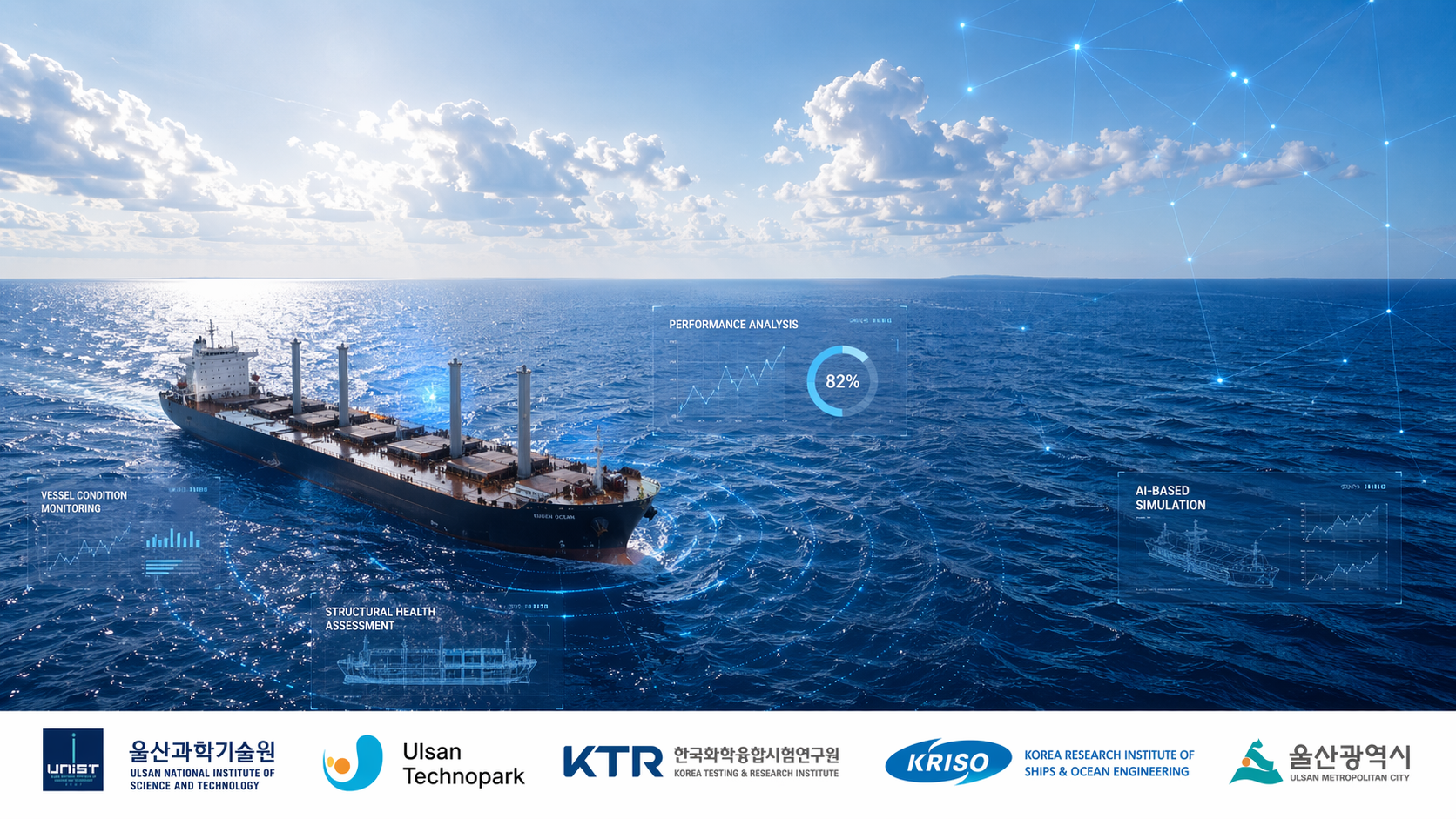
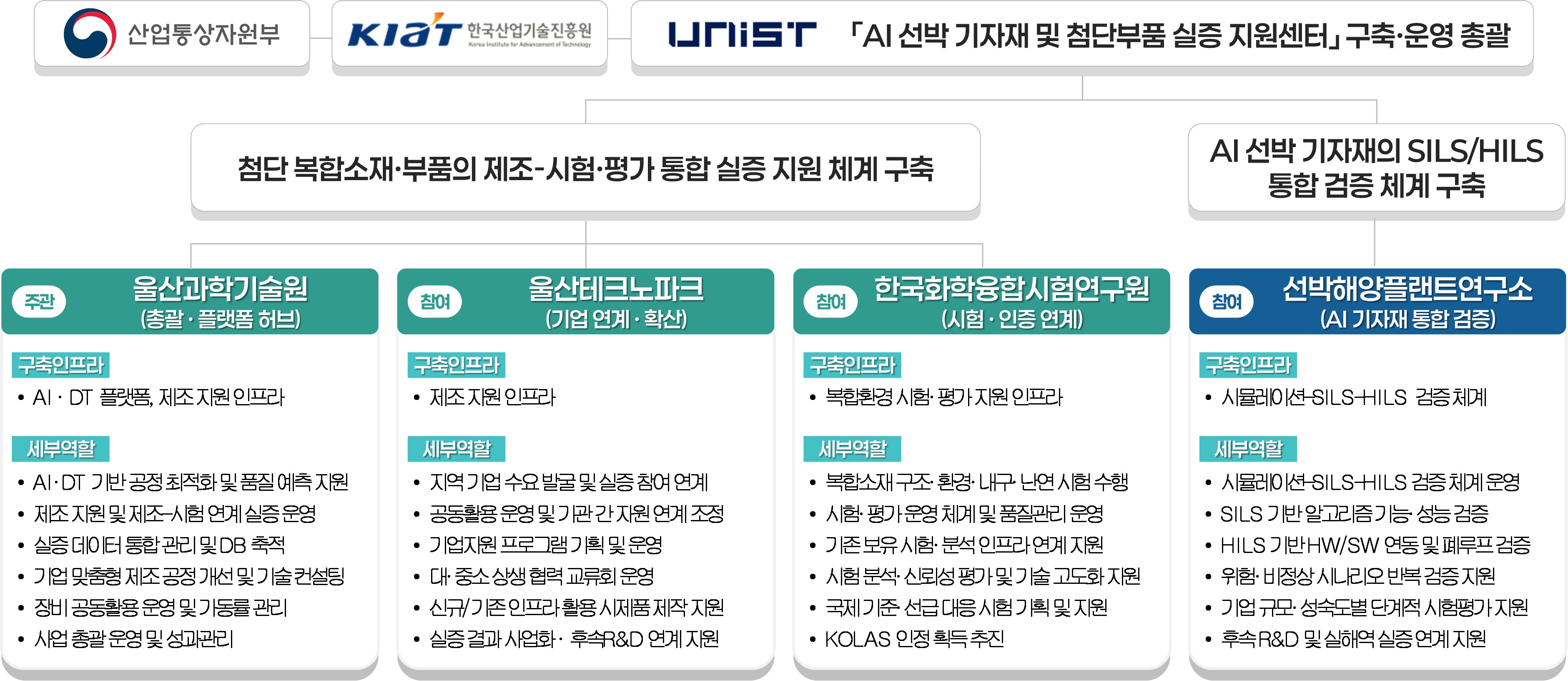
UNIST has secured a government-funded project to establish a testing and validation center for AI-based ship equipment and advanced components, marking a major step toward advancing Korea’s shipbuilding industry.
The project, supported by the Ministry of Trade, Industry and Energy (MOTIE), was selected under a 2026 government initiative to strengthen infrastructure in the shipbuilding and offshore sector. With a total budget of KRW 38.2 billion, it will support the development and validation of AI-driven autonomous ship systems and advanced composite materials in response to tightening environmental regulations led by the International Maritime Organization (IMO), as well as evolving industry demands.
Scheduled for completion by 2030, the center will be located in the Ulsan Mipo National Industrial Complex. UNIST will oversee its construction and operation in collaboration with the Ulsan Metropolitan Government, with participation from Ulsan Technopark, the Korea Testing & Research Institute (KTR), and the Korea Research Institute of Ships and Ocean Engineering (KRISO).
Designed as an end-to-end validation platform, the facility will support the full development cycle—from design and prototyping to performance testing and certification readiness. In the advanced components domain, it will enable the validation of fiber-reinforced plastic (FRP)-based ship structures, exterior materials, and propulsion components under real-world operating conditions, including mechanical stress, corrosion, and cryogenic environments. The center will also incorporate AI- and digital twin-based manufacturing systems to enhance process optimization, quality control, and productivity.
For AI-based ship systems, the center will establish a hybrid validation environment combining simulation and field testing, supporting the evaluation of autonomous navigation algorithms, sensor modules, and control systems in terms of safety, reliability, and repeatability, and accelerating commercialization.
The center is expected to play a key role in supporting small and mid-sized shipbuilding suppliers by improving access to testing infrastructure and validation data, thereby strengthening industrial competitiveness and facilitating entry into global markets.
Professor Young-Bin Park of the Department of Mechanical Engineering at UNIST, who leads the project, said, “This initiative will help bridge the gap between technology development and commercialization, supporting the advancement of environmentally sustainable and intelligent shipbuilding."
Related Links
Related Photo