UNIST site map
- Admissions
-
Academics
- Colleges and Schools
-
Academic Affairs
- Academic Calendar
- Academic Curriculum
- Requirements for Graduation
- Browse Open Courses
- Undergraduate Administration
-
Graduate Academic Affairs
- Tuition Fee Payment
- Academic Leave of Absence/ Academic Return
- Voluntary Withdrawal/ Expulsion
- Change of Major
- Change of Degree Program/ Dropping of Degree Program
- Class Period/ Attendance Period/ Academic Year・Semester
- Course Registration
- Course Drop
- Attendance/ Grade/ Exam
- Credit Transfer/ Credit Carryover
- Academic Forms
- Education Support
-
Research/Industry
- Research Aims
- Research Findings
- Researcher Search
-
Research Organizations
- UNIST Multi-Interdisciplinary Institute
- IBS Research Groups
-
UNIST Labs
- Department of Mechanical Engineering
- School of Energy and Chemical Engineering
- Department of Civil
- Department of Materials Science and Engineering
- Department of Nuclear Engineering
- Department of Industrial Engineering
- Department of Design
- Department of Biomedical Engineering
- Department of Biological Sciences
- Department of Electrical Engineering
- Department of Computer Science and Engineering
- Department of Mathematical Sciences
- Department of Chemistry
- Department of Physics
- School of Business Administration
- Graduate School of Carbon Neutrality
- Graduate School of Artificial Intelligence
- Research Support
- University-Industry Relations
- Campus Life
- News Center
- About UNIST
-
etc
- UNIST Bulletin
- Work-Life Balance Support System
- UNIST Gender Equality Plan
- Faculty Invitation for Tenure Track
- Faculty Invitation for Non-Tenure Track
- Board Meeting Minutes
- University Council Meeting Minutes
- Administrative Service Charter
- Privacy Policy
- Copyright Policy
- Rejection of Unauthorized Email Collection
- Operation and Management Policy for Video Information Processing Devices
- Information Disclosure


Connection Points of Knowledge, Everything About UNIST
Try searching.
Recommended search terms


- portal
- U Academics Innovation Center
- Leadership Center
- Dormitory
- Academic Information Center
- International Students Support
- Browse Open Courses
- Course Registration
- Graduation Requirements for Graduation
- Academic Leave of Absence/ Academic Return
- Military Service
- Certificate Issuance
- Academic Calendar
- Scholarships
- Campus Map
- Campus Life Guidebook
- Health Care Center
- Human Rights Center
- portal
- Job Opening
- Announcement for Bid
- UNIST AI Services
- UNIST Daycare Center
- Sports Center
- UI Downloads
- Announcement
- Recruitment of Professors (Non-tenure)
- Faculty Invitation for Tenure Track
- UNIST Academic Information Center
- Office of Research Facilities and Training
- Office of Research Affairs
- Rule Management System
- Academic Calendar


This is a collection of menus necessary for UNIST students .
students
- portal
- U Academics Innovation Center
- Leadership Center
- Dormitory
- Academic Information Center
- International Students Support
- Browse Open Courses
- Course Registration
- Graduation Requirements for Graduation
- Academic Leave of Absence/ Academic Return
- Military Service
- Certificate Issuance
- Academic Calendar
- Scholarships
- Campus Map
- Campus Life Guidebook
- Health Care Center
- Human Rights Center


This is a collection of menus necessary for prospective UNIST Students .
prospective Students


This is a collection of menus necessary for UNIST Faculty & Staff .
Faculty & Staff
- portal
- Job Opening
- Announcement for Bid
- UNIST AI Services
- UNIST Daycare Center
- Sports Center
- UI Downloads
- Announcement
- Recruitment of Professors (Non-tenure)
- Faculty Invitation for Tenure Track
- UNIST Academic Information Center
- Office of Research Facilities and Training
- Office of Research Affairs
- Rule Management System
- Academic Calendar


NEWS CENTER
Discover not only Research Findings and event news, but also the diverse facets of UNIST presented by reporters and writers.
News Center

UNIST News
Spiral Nanowires Serve as Quantum Pumps for Quantized Electron Transport
Published in the May 2026 issue of Nano Letters, the results deepen understanding of quantum topological phenomena and point toward new designs for nanoscale electronic and spintronic devices.
- Research
- JooHyeon Heo
- 2026.06.05
- 187
Abstract
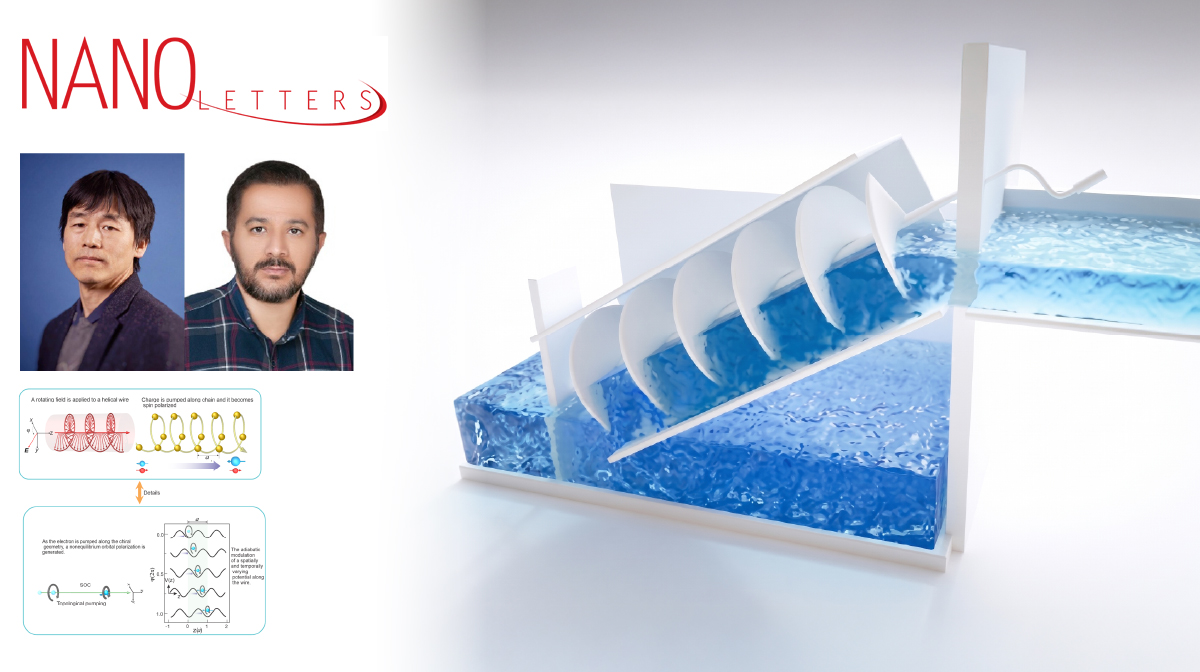
A new theoretical study has demonstrated that a spiral-shaped nanowire can function as a quantum pump—transferring electrons in precise, quantized amounts. This discovery reveals a novel approach to controlling charge flow at the nanoscale, grounded in the topological properties of the material.
Led by Professor Noejung Park of the Department of Physics at UNIST, in collaboration with researchers at Pennsylvania State University, the team shows that a one-dimensional, screw-like chiral material can generate a topological charge pump. During this process, the system also produces orbital angular momentum and spin polarization, unveiling new connections between topology and quantum transport.
The concept draws inspiration from the ancient Greek Archimedean screw, a device used to lift water through rotation. In the quantum realm, a similar structure—an electron traveling along a spiral nanowire—can induce directed charge flow by cyclically modulating its quantum states.
Unlike conventional currents driven by voltage, this effect involves gradually varying system parameters to achieve a quantized transfer of electrons with each cycle, fundamentally linked to the topological nature of the material.
First proposed by Nobel laureate David Thouless in 1983, topological charge pumping enables electrons to move in discrete steps without applying an external voltage. While this phenomenon has been realized in various engineered systems, the current work demonstrates that a simple modulation of the electric field's direction in a chiral nanowire is sufficient to produce quantized charge transport.
This insight simplifies the pathway toward practical topological devices, eliminating the need for multiple control parameters previously deemed necessary.
Using advanced time-dependent simulations of multiorbital models and density functional theory calculations, the researchers examined electrons in spiral hydrocarbons and selenium nanowires. They found that as electrons are pumped along the wire, orbital angular momentum becomes dynamically polarized. In selenium nanowires, a portion of this orbital polarization converts into spin polarization via spin-orbit coupling, establishing a topological mechanism akin to the chirality-induced spin selectivity (CISS) effect.
Using advanced time-dependent simulations of multiorbital models and density functional theory calculations, the team examined electrons in spiral hydrocarbons and selenium nanowires. They observed that as electrons are pumped along the wire, orbital angular momentum becomes dynamically polarized. In selenium nanowires, part of this orbital polarization converts into spin polarization via spin-orbit coupling, creating a topological mechanism similar to the chirality-induced spin selectivity (CISS) effect.
Professor Park notes, "This work shows that charge, orbital, and spin behaviors are interconnected through a topological process in chiral nanowires. It opens pathways to control these properties electrically at the nanoscale."
Published in the May 2026 issue of Nano Letters , the study involved Dr. Esmaeil Taghizadeh Sisakht from UNIST. It was supported by the National Research Foundation of Korea (NRF), the Ministry of Science and ICT (MSIT), the Korea Institute for Advancement of Technology (KIAT), and the Ministry of Trade, Industry and Energy (MOTIE).
Journal Reference
Esmaeil Taghizadeh Sisakht, Uiseok Jeong, Xiao Jiang, et al ., “Spin and Orbital Angular Momentum Polarization in Thouless Topological Charge Pumping,” Nano Letters, (2026).
Related Links



-
UNIST Unveils Transfer-Free Method for 2D Semiconductor LED Production
-
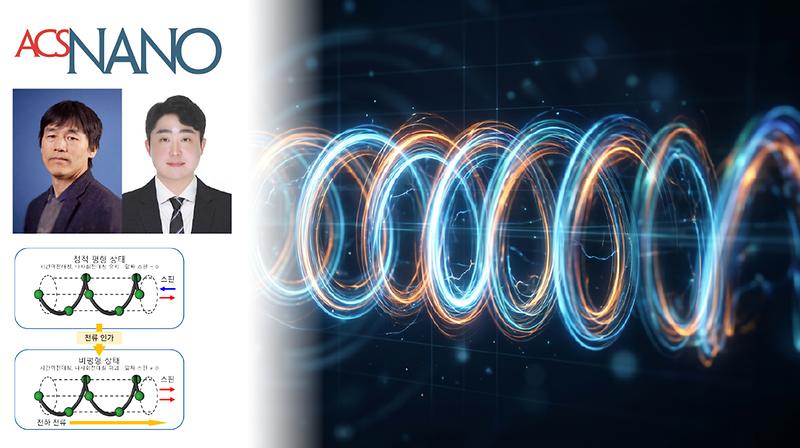
New Study Uncovers Current-Driven Spin Polarization in Chiral Nanowires
-
Innovative Nanoscale Design Produces Stronger Signals When Bent
-
New Study Unveils High-Purity, Electrically Controlled Single-Photon Source for Quantum Technologies